

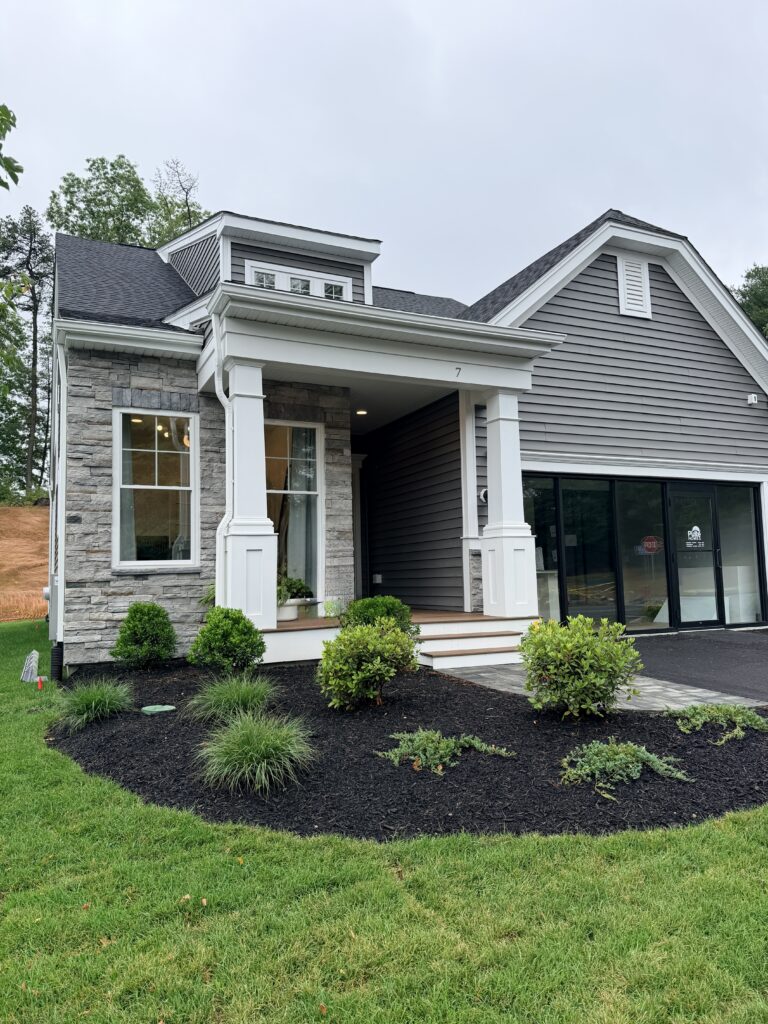
What could Needham‘s Large House Review mean for teardowns, new construction, and the future of luxury homes in town?
Needham’s Large House Review Committee is advancing zoning changes that could reshape how large new homes are built, directly affecting teardown economics, buildable square footage, and property values across every neighborhood in town.
Why This Matters Right Now in Needham
If you are buying, building, or even thinking about selling in Needham, MA, the Large House Review is the single most consequential local policy conversation happening in 2026. It is not abstract. It is not hypothetical. It is a set of specific zoning proposals, including revised floor area ratios, lower maximum building heights, and sliding-scale lot coverage rules, that are currently before the Needham Planning Board.
Here is why you should care: between July 2013 and June 2023, the town issued 944 building permits for single-family and two-family houses, according to data from the Needham Large House Review Study Committee. Of those, roughly 840, or 89%, were replacement homes built on lots where an existing house had been demolished. Teardowns are not a niche phenomenon in Needham. They are the primary engine of new housing production, and these proposed zoning changes would directly alter what can be built on those lots.
How Teardowns Became Needham’s Dominant Building Pattern
You might wonder how a town of roughly 31,800 residents became so defined by teardown activity. The answer comes down to simple math: there are almost no vacant lots left.
According to the Large House Review Committee’s own findings, the demolition of older, smaller, and less expensive houses has become the principal source of lots for the construction of new single-family houses. During the earlier wave from 2008 to 2013, the town issued 317 building permits for single-family houses, and 289 of them, or 92%, were replacement homes built on teardown lots, per the committee’s published data.
What I tell my clients is that if you want new construction in Needham, you are almost always buying a home that replaced something else. That is the market reality. Whether you are looking at the colonial-lined streets off Central Avenue in the Newman Area, the Highland Avenue corridor in Needham Heights, or the walkable blocks near Great Plain Avenue in Needham Center, the same dynamic applies. Developers acquire older homes, demolish them, and build larger, modern houses that command premium prices.
This pattern is a major reason Needham’s year-to-date median single-family sale price reached $2,359,500 as of early 2026, per Resideline market data. That figure represents a 62% increase from the $1,455,000 median in 2022. But here is the nuance that matters: the price per square foot only moved from $516 to $544 over the same period, roughly 5.5%. The land itself has not skyrocketed. What changed is what is being built on that land: bigger, newer homes with more interior square footage.
What the Needham Large House Review Committee Is Actually Proposing
So what would these zoning changes do to the homes you can buy or build? Let me walk you through the key proposals that advanced through the committee as of December 2025 and were the subject of a March 2026 Planning Board public hearing.
Floor Area Ratio (FAR) Revisions
The committee identified that the current FAR definition contains practical loopholes. As the committee documented, today FAR counts first and second floors and excludes basements, attics, up to 600 square feet of garage, and unenclosed porches. The result is that builders can construct much larger homes than the Planning Board originally intended when it adopted FAR limits in 2017. The proposed changes would tighten what counts toward interior floor space, with a 300-square-foot attic bonus discussed as a compromise.
Height, Lot Coverage, and Setbacks
The committee signaled support for a mid-range package of dimensional changes, including lower maximum heights, a sliding lot-coverage scale that favors smaller lots, and narrower side-wall plates. The framework was split into three warrant articles covering setbacks, height, and coverage/FAR, and sent to the Planning Board for public hearings.
The March 2026 Public Hearing
At the March 4, 2026 public hearing, the Planning Board considered four zoning articles from the committee. Presenters described the sliding-scale limits, while many residents expressed concerns about reduced property values and impacts on seniors. The board closed the hearing and indicated it would review corrected fiscal analysis before voting.
What These Changes Could Mean If You Are Buying New Construction in Needham
If you are actively shopping for new construction in Needham, you need to think about these proposals through two lenses: what happens to inventory and what happens to price.
The Inventory Question
Over half of Needham’s active inventory is already less than a decade old. That is extraordinary for a town with housing stock dating back generations. If the new zoning passes, the homes that get built going forward would likely be somewhat smaller than what has been going up in recent years. For buyers who prefer something in the 3,500 to 4,500 square foot range rather than the 5,000 to 7,400 square foot new builds currently common in neighborhoods like Birds Hill and Needham Heights, tighter zoning could actually produce homes that better match your preferences.
The Price Question
Here is where it gets interesting. Because developers can sell the large homes at a premium, they can outbid home buyers who would potentially purchase and move into an existing older house, according to the committee’s analysis. If the zoning reduces the maximum buildable size, the economic incentive for teardowns could narrow. A developer who can only build a 4,000 square foot home instead of a 6,000 square foot home may not be able to offer the same price for the teardown lot. That could, in theory, slow the pace of demolitions and preserve some of Needham’s older housing stock.
But “slow” does not mean “stop.” With a homeownership rate of 83.1%, a median household income of $214,308, and schools ranked number 2 in Massachusetts by MCAS composite scoring, the demand drivers that fuel Needham’s market are not going anywhere.
How Neighborhoods Across Needham Could Be Affected Differently
Not every part of town will feel these changes the same way.
Needham Heights
The Heights already has some of the most active teardown and new construction activity in town, particularly along Highland Avenue and Greendale Avenue. The housing stock skews toward 1950s and 1970s colonials and Capes, which are exactly the homes that tend to get targeted for demolition. If you are considering buying an older home in Needham Heights near the commuter rail station, with its 30 to 35 minute ride to South Station, the zoning changes could actually help protect the neighborhood character that attracted you in the first place.
Country Way and Needham Center
Country Way has seen some of the highest individual sale prices in town, and Needham Center’s walkability near Great Plain Avenue, the Town Common, French Press Bakery, Sweet Basil, and Spiga Ristorante commands its own premium. Luxury buyers in these areas who want the largest possible new build should pay close attention to the timeline of any zoning adoption.
Newman Area and Olin Woods
The generous lots along Central Avenue, Oxbow Road, and Bridle Trail could be particularly affected by the sliding lot-coverage scale, which the committee designed to favor smaller lots. Larger parcels in this area may retain more building flexibility even under the new rules, making Newman and Olin Woods potentially more attractive for buyers who want maximum square footage paired with proximity to the Town Forest.
What Sellers of Older Needham Homes Should Consider
If you own an older home and have been thinking about selling, the Large House Review adds a layer of strategy to your decision. With 25 years of experience helping homeowners in Needham navigate exactly these kinds of transitions, and having closed over 252 transactions in this market, I can tell you that timing matters here.
Right now, the economics still strongly favor teardown buyers for certain properties. But if the zoning tightens the buildable envelope, the premium a developer would pay for your lot could decrease. That does not necessarily mean your home’s value drops; it could mean more traditional buyers, families who actually want to live in the existing house, become competitive again.
The town has 5,103 properties with more than 50% equity and only 2 foreclosures on the books, according to current market data. Needham homeowners are in extraordinarily strong financial positions. The question is not whether your home has value. It is whether you maximize that value by selling before or after any zoning changes take effect.
The Bigger Picture for Needham’s Luxury Market
Needham’s FY2026 residential tax rate is $10.83 per $1,000 of valuation, and the average single-family assessed value increased 22.28% to $1,464,398, according to town records. Average annual taxes on a single-family home run roughly $15,500. These numbers reflect a town that is investing in itself, and buyers keep responding.
With only about 33 to 38 homes available at any given time and 38% of homes selling over asking price, per current market data from Resideline, the fundamental supply-demand equation in Needham remains tilted heavily toward sellers. What I have seen over 25 years of living and working in this community is that smart zoning policy and strong property values are not mutually exclusive. Needham has proven that repeatedly.
Frequently Asked Questions About Needham’s Large House Review
What is the Needham Large House Review?
The Large House Review is a study conducted by a committee appointed by Needham’s Planning Board. It examines whether the zoning changes adopted in 2017 are adequately regulating the size of new homes relative to their lots, and it has proposed additional changes to FAR, lot coverage, building height, and setbacks.
Why did Needham reopen the Large House Review in 2024?
Concerns expressed at the May 2024 Annual Town Meeting prompted the Planning Board to revisit the issue. Residents and committee members noted that the current FAR definition allows builders to exclude basements, attics, garages up to 600 square feet, and porches, enabling homes much larger than originally intended.
What percentage of Needham’s new homes are teardowns?
According to committee data, between July 2013 and June 2023, roughly 840 of 944 building permits issued (89%) were for replacement homes built on lots where existing houses were demolished.
Will the Large House Review lower property values in Needham?
This is a key concern raised at the March 2026 public hearing. Many residents warned about potential impacts on property values. However, no final fiscal analysis has been adopted, and the Planning Board indicated it would review corrected data before voting.
How does FAR work under current Needham zoning?
Currently, FAR in Needham counts first and second floor area and excludes basements, attics, up to 600 square feet of garage space, and unenclosed porches. The proposed changes would tighten these exclusions, potentially including a 300-square-foot attic bonus as a compromise.
What neighborhoods in Needham are most affected by teardowns?
Needham Heights, with its older colonial and Cape housing stock along Highland Avenue, and the single-family neighborhoods across the SRB (Single Residence B) and GR (General Residence) districts have seen the most teardown activity over the past decade.
How much does new construction cost in Needham in 2026?
The year-to-date 2026 median single-family sale price is $2,359,500, per Resideline data. In the $2.5M to $3M range, buyers typically find 5,000 to 7,400 square feet of new or nearly new construction with premium finishes.
What zoning changes were adopted in Needham in 2017?
The 2017 changes included revised side and rear yard setbacks, new height requirements, increased garage setback requirements, an FAR requirement in the SRB district, and lot coverage requirements in both SRB and GR districts, all adopted at May 2017 Town Meeting.
Could the new zoning slow Needham’s teardown pace?
Potentially, yes. As the committee noted, if the zoning reduces the maximum buildable envelope, the economics of teardowns could shift because developers may not be able to build homes large enough to justify the acquisition cost of existing properties.
When will the new Needham zoning rules be voted on?
As of the March 2026 public hearing, the Planning Board closed testimony and indicated it would review corrected fiscal analysis before voting. The framework was split into three warrant articles. You should monitor the Planning Board’s schedule for updates on when these articles move forward.
The Bottom Line on Needham’s Large House Review
Whether you are buying your first home in Needham, building new construction, or weighing whether to sell a property that might attract a developer, the Large House Review is shaping the market you are entering. The proposals are real, the timeline is active, and the implications touch every neighborhood from Needham Center to Birds Hill to the Newman Area.
With 130 five-star reviews, a 5.0 average rating, and recognition as a RealTrends Top 1.5% agent and Boston Magazine Top Producer, I have guided hundreds of Needham families through exactly these kinds of market-shaping moments. If you want to understand how these zoning changes affect your specific property or purchase plans, I am here to help you think it through. You can reach me, Nancy Moore, at Gibson Sotheby’s International Realty, 936 Great Plain Ave, Needham, MA 02492, or call me directly at (781) 424-3527.

Nancy Moore · Gibson Sotheby's International Realty
Vice President & Associate Broker — Needham & Boston Suburbs
Get in touch →