

Is Needham, MA truly becoming more walkable, and should that factor into your home buying decision?
Yes, Needham is becoming more walkable, but it is happening incrementally through targeted town planning and village center improvements rather than one dramatic overhaul. The biggest gains are visible in Needham Center and Needham Heights.
Why Needham’s Walkability Matters to Buyers Right Now
If you are shopping for homes for sale in Needham, MA, walkability is no longer just a lifestyle perk. It is a value driver. The homes closest to Needham’s walkable village centers, particularly along Great Plain Avenue and near the MBTA commuter rail stations, consistently attract the strongest buyer interest and tend to hold value exceptionally well.
What I tell my clients is this: Needham is becoming more walkable, but it is happening incrementally rather than through one dramatic transformation. The clearest evidence is in Needham Center and in the town’s broader street-planning policies. That distinction matters enormously when you are deciding which sub-neighborhood to target.
With the median single-family home in Needham now sitting at $1,655,000 and the median listing price hovering around $2.2 million, every advantage that protects your investment counts. Walkability is one of the strongest long-term indicators of property appreciation, and Needham’s town government is actively investing in it.
What Needham’s Street Design Guide Means for Your Investment
Here is where the walkability story gets concrete. The Town of Needham, through its Mobility Planning and Coordination Commission, has launched a formal Needham Street Design Guide project. This is not a wish list. It is a funded initiative backed by MassDOT’s Chapter 90 program, with technical assistance from the Metropolitan Area Planning Council.
The Design Guide will classify every street in town by type and function, then identify where sidewalks, bicycle infrastructure, and transit improvements are most needed. The stated goals include improving drainage, reducing urban heat islands, supporting environmentally sustainable design, and fostering vibrant business districts through walkable, welcoming streets.
Community forums were scheduled for December 2025 and Spring 2026, which means the planning framework is actively being shaped right now.
So what does that mean for you as a buyer? It means the town is not leaving walkability to chance. One family I worked with recently was torn between a home on a quiet street in Birds Hill and a slightly smaller property closer to Needham Center. When we discussed the trajectory of town planning and what the Street Design Guide signals about future infrastructure, they chose the walkable location. Their reasoning was simple: they wanted a home that would appreciate not just because of the house itself, but because of what the surrounding neighborhood would become over the next decade.
Where You Can Walk Today in Needham, MA
Not every pocket of Needham offers the same walkability, and this is a critical nuance that the best Needham, MA real estate agents will walk you through, literally.
Needham Center: The Most Walkable Neighborhood
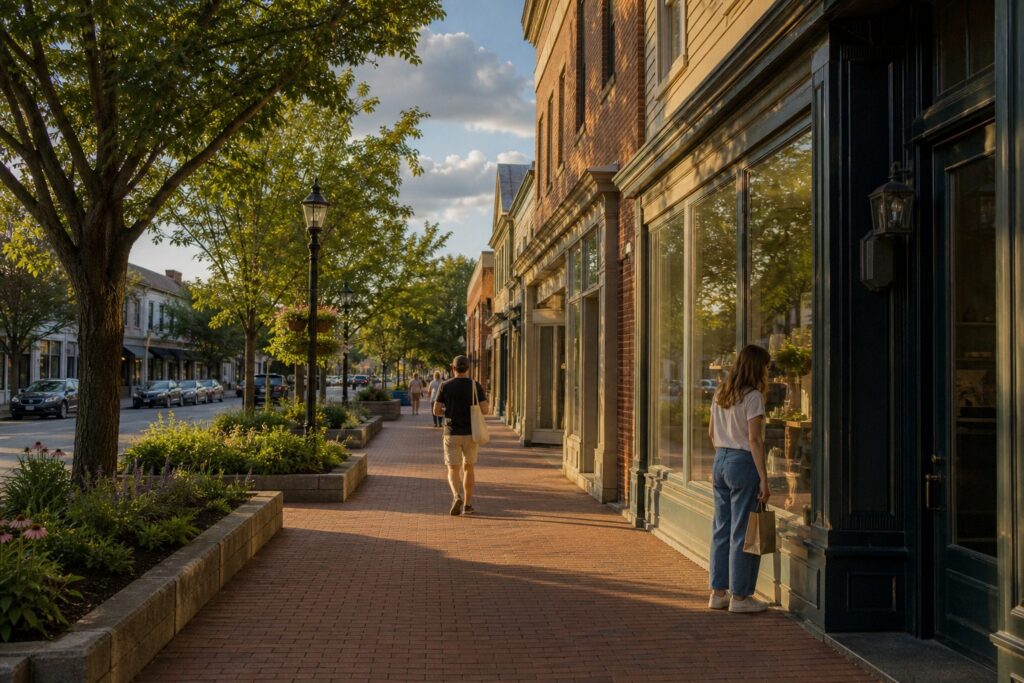
Needham Center is the historic downtown and the most walkable place in town. The spine is Great Plain Avenue, lined with restaurants and shops. Key intersections that define the walkable core include:
- Great Plain Avenue and Eaton Square, where the MBTA commuter rail station sits
- Great Plain Avenue and Highland Avenue, where retail density is highest
- Chestnut Street and Central Avenue, connecting residential blocks to downtown
Within this compact zone, you can walk to French Press Bakery and Café for morning coffee, grab dinner at Blue on Highland or The Farmhouse, pick up produce at Volante Farms, and even bowl a few frames at the legendary Needham Bowlaway, a 100-plus-year-old alley beneath a former post office. The town reports 23 restaurants, cafes, and eateries and 20 retail shops and boutiques within the center.
Needham Heights: The Commuter’s Walkable Option
Needham Heights offers a compact village center near Highland Avenue with cafés and everyday services. With its own MBTA commuter rail station, residential streets close to the station are among the town’s most walkable pockets. Having closed over 252 transactions in this market over 25 years, I can tell you that turnkey homes near the Heights station that are walkable and energy efficient tend to draw interest faster than comparable homes without that proximity.
The Rest of Town
Outside these village centers, Needham is still primarily car-dependent. That is the honest answer. The town’s 300-plus acres of parkland, including Needham Town Forest, Needham Reservoir, and the Charles River Peninsula, are magnificent for recreation, but most require driving to reach.
The Needham-Newton Corridor Project and Its Impact on Walkability
Beyond the Street Design Guide, MassDOT is actively improving the Needham-Newton corridor with significant infrastructure upgrades. The project includes widened roadways, new pavement, raised bike lanes, new sidewalks, a shared-use path for bikes and pedestrians, new traffic signals, and stormwater improvements.
This is the kind of infrastructure investment that does not just improve safety. It changes how neighborhoods feel and function. When a corridor gains raised bike lanes and dedicated pedestrian paths, the properties along it and nearby become more desirable.
What does this look like in practical terms? A couple I recently helped relocate from the city to Needham was specifically looking for a suburb where they would not feel trapped in their car every time they needed milk or wanted to grab dinner. They had two young kids and no interest in strapping everyone into car seats for a five-minute drive. We focused their search within a half-mile of Needham Center, and they ended up in a home where Saturday mornings now involve walking to the town center and grabbing pastries at French Press. That walkability was not a bonus feature for them. It was the deciding factor.
How Walkability Affects Needham, MA Home Values
You might be wondering whether walkability actually moves the needle on price. The data says yes, and Needham’s numbers support it.
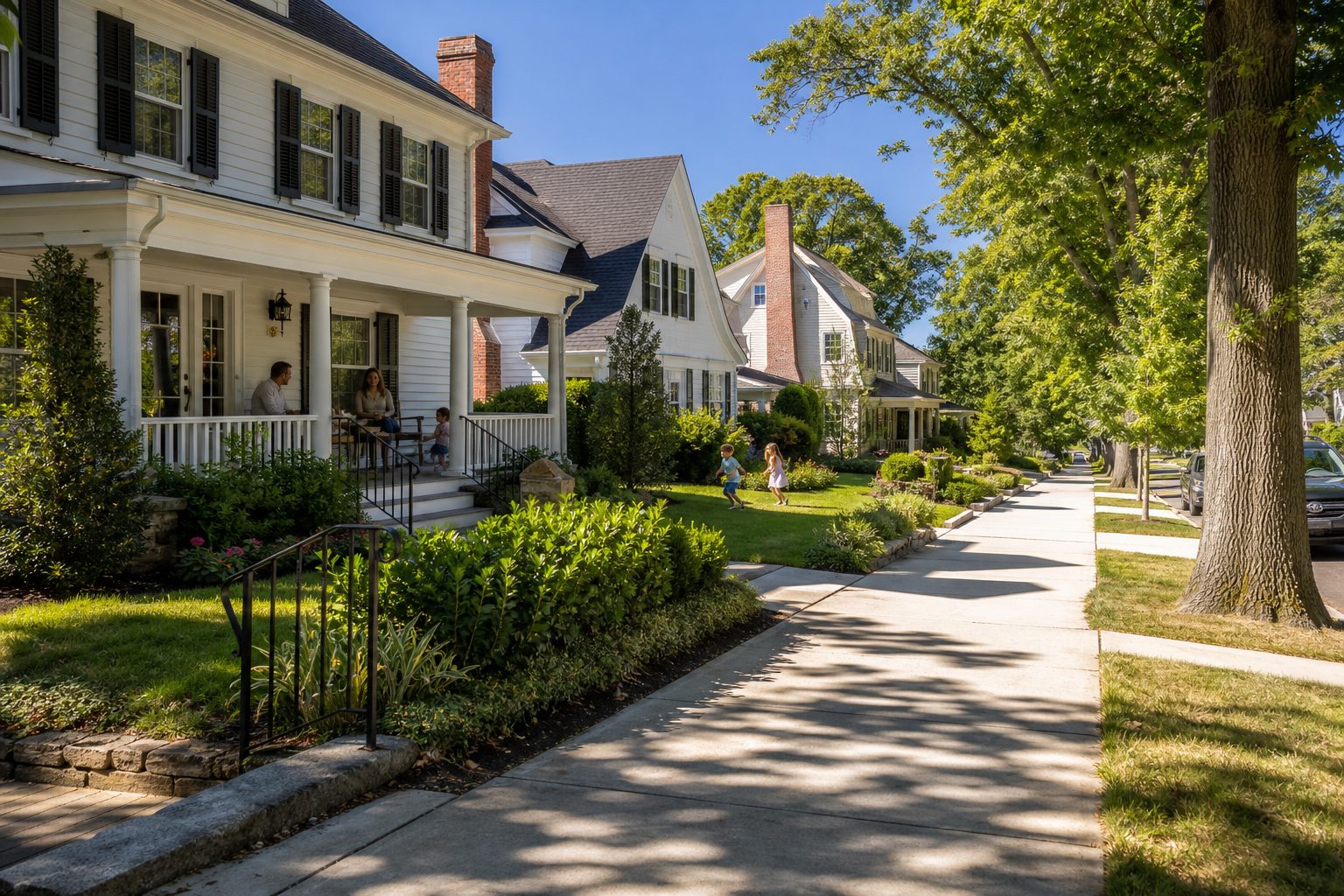
The median listing price in Needham is approximately $2.2 million, up about 9.8% year over year. Average assessed property values increased by 22.28% to $1,464,398 in the most recent fiscal year. While these increases reflect the entire town, homes in walkable pockets near Needham Center and Needham Heights consistently trade at the higher end of the range.
Consider the broader picture: Needham’s median single-family sale price has climbed from $1,455,000 in 2022 to $2,359,500 in early 2026, a 62% increase. Much of that growth has been driven by new construction, but location within the town, specifically proximity to walkable amenities and commuter rail stations, plays a significant role in which homes command premiums.
With 130 five-star reviews from past clients and recognition as a RealTrends Top 1.5% agent and Boston Magazine Top Producer, what I consistently see is that buyers who prioritize walkability in Needham are not just buying a lifestyle. They are making a strategic investment. The town’s incremental walkability improvements compound over time, and properties near those improvements benefit.
The Transit Connection That Makes Needham’s Walkability Work
Walkability in a suburb means something different than it does in Boston. In Needham, the walkability story is inseparable from the MBTA commuter rail. The town has four stations: Needham Heights, Needham Center, Needham Junction, and Hersey. That is extraordinary for a town of this size.
The Needham Center station gets you to South Station in 30 to 40 minutes. If you live within walking distance of that station, your entire commute, from front door to office, can be done without a car. Pair that with the density of restaurants, shops, and services along Great Plain Avenue, and you start to see a suburban lifestyle that genuinely minimizes car dependence for daily needs.
For buyers evaluating Needham’s walkability, the right question is not “Is Needham walkable?” but rather, “Which part of Needham matches the walkability level I need?”
Frequently Asked Questions
Is Needham, MA walkable compared to other MetroWest suburbs?
Needham is more walkable than most MetroWest towns in its village centers, particularly Needham Center and Needham Heights. The presence of four MBTA commuter rail stations, combined with a dense downtown along Great Plain Avenue featuring 23 restaurants and 20 retail shops, gives it an advantage that many comparable suburbs lack.
What is the most walkable neighborhood in Needham, MA?
Needham Center is the most walkable neighborhood, anchored by Great Plain Avenue and the intersection at Eaton Square. You can walk to restaurants like Blue on Highland and The Farmhouse, grab coffee at French Press Bakery, and catch the commuter rail within a few blocks.
Is the Town of Needham investing in walkability improvements?
Yes. The town has launched a formal Street Design Guide project, funded through MassDOT’s Chapter 90 program, to classify streets and prioritize sidewalk, bike, and transit infrastructure. MassDOT is also improving the Needham-Newton corridor with raised bike lanes, new sidewalks, and a shared-use path.
How does walkability affect home prices in Needham, MA?
Homes near Needham’s walkable centers and commuter rail stations tend to sell at the higher end of the market. The median listing price is approximately $2.2 million, and walkable proximity to Great Plain Avenue is one factor that drives premiums in the Needham Center area.
Can you live in Needham without a car?
You can manage daily errands on foot if you live near Needham Center or Needham Heights, and the commuter rail connects you to Boston. However, you will likely still need a car for some activities, school drop-offs in certain neighborhoods, and reaching destinations outside the village centers.
What restaurants are within walking distance in Needham Center?
Needham Center features Blue on Highland, The Common Room, Cook Needham, The Farmhouse, and French Press Bakery and Café, all within a compact, walkable downtown area along Great Plain Avenue and Highland Avenue.
Are there walkable parks and trails in Needham, MA?
The town stewards over 300 acres of parkland, including Needham Town Forest, Needham Reservoir, Rosemary Lake, and the Charles River Peninsula. Needham Town Forest is notable for its hiking trails and the quirky Martini Junction model-train installation. Some parks are walkable from residential neighborhoods, while others require driving.
How far is the Needham Center commuter rail from downtown shops?
The Needham Center MBTA station at Eaton Square is steps from Great Plain Avenue, making it one of the most convenient suburban train-to-downtown-shopping combinations in the MetroWest area.
What is Needham Heights like for walkability?
Needham Heights has a compact village center near Highland Avenue with cafés and everyday services. Streets near the commuter rail station are among the most walkable residential pockets in town, and the neighborhood draws strong buyer interest for that reason.
Should walkability factor into my Needham, MA home search?
Absolutely. Walkability is both a lifestyle benefit and a long-term value protector. With the town actively investing in street design improvements and the Needham-Newton corridor gaining new pedestrian and bike infrastructure, buying in a walkable pocket positions you well for appreciation over the coming decade.
The Bottom Line on Needham’s Walkability
Needham, MA is becoming more walkable, but the transformation is happening in deliberate, incremental steps rather than overnight. If walkability matters to you, focus your search near Needham Center along Great Plain Avenue or near the Needham Heights commuter rail station. These areas already offer a walkable daily life, and the town’s investment in its Street Design Guide and the MassDOT corridor project signals that more improvements are coming.
With 25 years helping buyers navigate the Needham market and a deep understanding of how each sub-neighborhood functions day to day, I can help you identify the exact streets and blocks where walkability, schools, and value intersect. If you are exploring homes for sale in Needham, MA, and want to make a decision grounded in local knowledge, reach out to me, Nancy Moore, at Gibson Sotheby’s International Realty. You can call me at (781) 424-3527 or visit my office at 936 Great Plain Ave in Needham. Let’s find the right walkable pocket for your family.

Nancy Moore · Gibson Sotheby's International Realty
Vice President & Associate Broker — Needham & Boston Suburbs
Get in touch →