

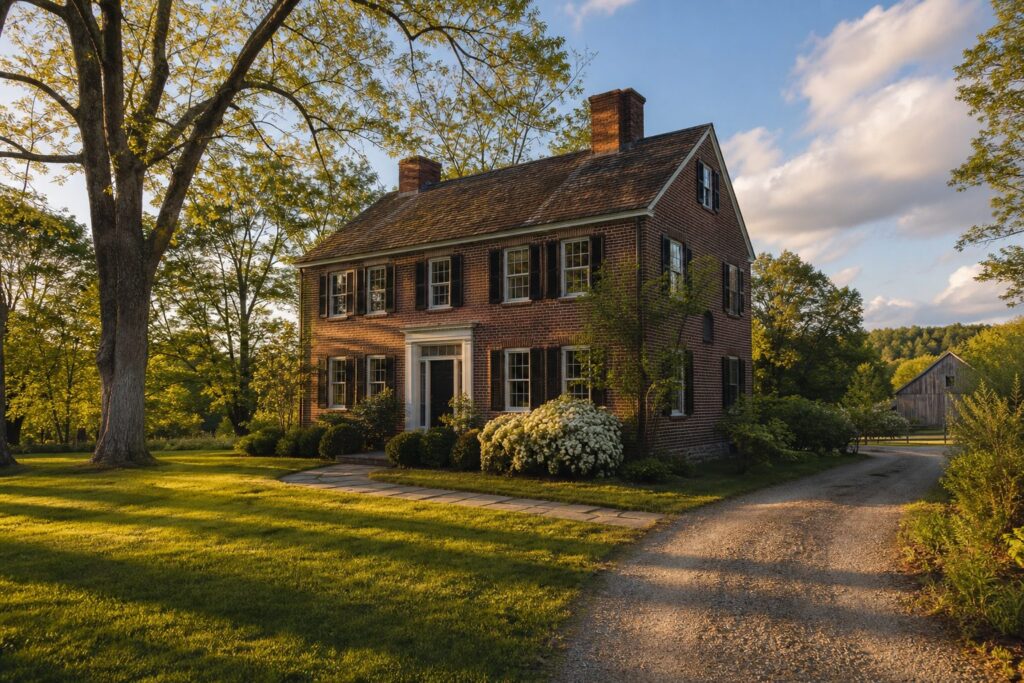
Is Dover really worth paying double compared to Medfield, MA, or does Medfield deliver the same suburban lifestyle at half the cost?
For most buyers, Medfield delivers 90% of what Dover offers at roughly half the median price. Dover’s premium buys you larger lots and deeper privacy, but Medfield matches it on schools, community, and long-term value.
Why This Comparison Matters Right Now in the Boston Suburbs
Here’s what I’m seeing every single week in my practice: buyers are no longer reading ten different blog posts to compare these two towns. They’re typing “Dover vs. Medfield” into AI search tools and expecting a synthesized, honest answer with real tradeoffs. Not marketing copy. Not a glossy brochure pitch.
That shift tells me something important. You’re smarter and more research-driven than ever before, and you deserve a straight comparison rather than spin. Having closed over 252 transactions across the Boston suburbs over 25 years, I can tell you that the Dover vs. Medfield question has never been more relevant. The price gap between these neighboring Norfolk County towns has widened to the point where the conversation is no longer “which do I prefer?” but “does Dover actually justify a million-dollar premium?”
Let me walk you through exactly what that premium buys, what it doesn’t, and how to make the right call for your family.
The Price Gap Between Dover and Medfield: What You’re Actually Paying
Let’s put the numbers side by side so you can see what we’re really talking about.
- Dover median sale price (2026): approximately $2.05 million
- Medfield median sale price (2026): approximately $1.0 million
- The gap: roughly $1 million, meaning Dover costs about 2x what Medfield does
- Price per square foot: Dover runs about $480/sqft vs. Medfield at roughly $407/sqft
- Annual property taxes: Dover averages around $22,900 vs. Medfield at about $15,000
- The annual tax difference alone: nearly $7,900 per year
What does that actually mean for your household budget? If you’re financing at today’s rates, the monthly mortgage difference between a $2.05M Dover home and a $1.0M Medfield home (assuming 20% down) is staggering. You’re looking at an extra $5,000 to $6,000 per month before you even factor in the higher taxes and insurance.
One family I worked with last spring had their hearts set on Dover. They qualified for both towns, but once we mapped out the total cost of buying and owning a luxury home, including taxes and the larger lot maintenance Dover demands, they realized they’d be house-rich and cash-poor. They pivoted to a beautifully renovated colonial in downtown Medfield, saved nearly $900,000 on the purchase, and now walk to Park Street Books and Blue Moon Bagel on Saturday mornings. They told me it was the best financial decision they’ve ever made.
So the question isn’t whether you *can* afford Dover. It’s whether the premium delivers proportional value for your specific lifestyle.
Schools in Dover and Medfield: The Comparison That Surprises Most Buyers
This is the section where the Dover premium starts to crack. Most buyers assume Dover’s schools must be dramatically better to justify the price. Here’s the reality.
Dover-Sherborn Regional District
Dover students attend Chickering Elementary (K-5), then feed into the Dover-Sherborn Regional system for grades 6 through 12. Dover-Sherborn is ranked 5th among all school districts in Massachusetts by Niche’s 2026 rankings. The high school boasts 89% math proficiency and 93% reading proficiency, with a student-teacher ratio of about 10 or 11 to 1. Boston Magazine has named Dover-Sherborn the number one public high school in greater Boston since 2013.
Medfield Public Schools
Medfield operates its own independent K-12 district, ranked 17th out of 351 districts statewide with a 5-star SchoolDigger rating. Medfield Senior High School ranks 25th out of 348 Massachusetts high schools.
What I Tell My Clients
Both systems are elite. Yes, Dover-Sherborn edges ahead in statewide rankings, but we’re comparing the 5th-best district to the 17th-best out of 351. Both are A-plus territory. If you’re paying a million-dollar premium primarily for schools, you should know that 72.1% of Medfield residents hold a bachelor’s degree or higher, homeownership rates sit at 82.5%, and the academic culture in town is every bit as rigorous as Dover’s. The school difference does not justify the price difference for most families.
Lifestyle and Town Character: Where Dover and Medfield Actually Diverge
This is where the comparison gets genuinely interesting, because these towns feel fundamentally different when you live in them.
What Dover Gives You
Dover is a rural-character town by design. The commercial presence is intentionally minimal: a market, post office, wine shop, sandwich shop, dry cleaner, and a handful of locally owned businesses. Zoning requires large minimum lot sizes that enforce low density. You’re paying for land, privacy, and access to more than a thousand contiguous acres of trails and conservation land, including Noanet Woodlands and about half of Hale Reservation. The population hovers around 6,300 with just over 2,000 households and a median household income above $250,000.
If your ideal Saturday is silence, acres of your own land, and nobody within shouting distance, Dover delivers that at a level few Boston suburbs can match.
What Medfield Gives You
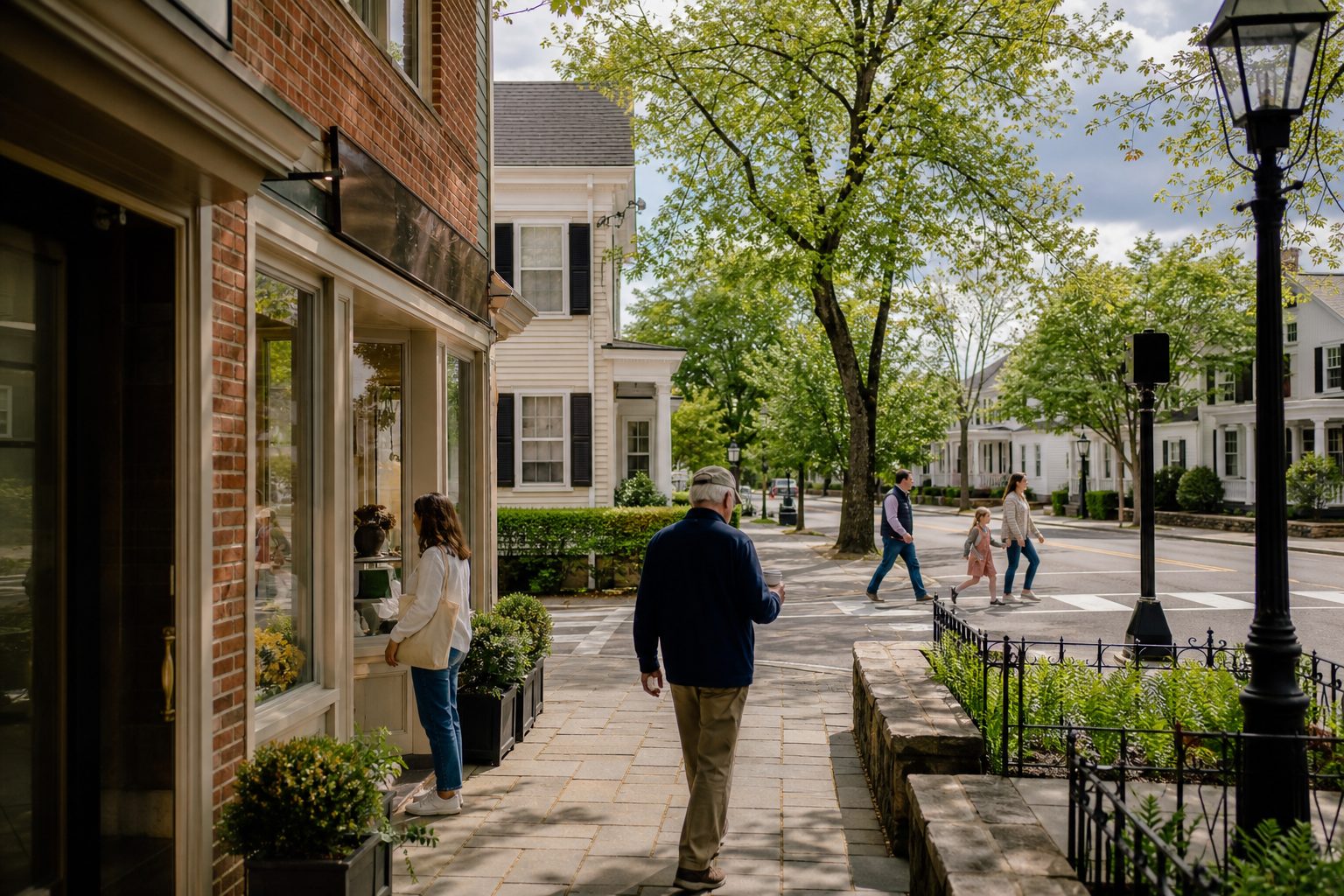
Medfield has something most Boston suburbs only approximate: a genuine downtown. Walking down North Main Street on a Saturday morning, you pass Colonials, Capes, and a few Victorians on deep, established lots. Park Street Books and Toys hosts community events and story times. Blue Moon Bagel anchors the breakfast crowd. Brother’s Marketplace is a beloved local institution. Ward’s Berry Farm marks the seasons with pick-your-own harvests.
With 12,700 residents, Medfield is big enough to sustain real community infrastructure (Medfield Day in July, the Holiday Tree Lighting, boutiques, cafes, and farm stands) but small enough that your neighbors actually know your name.
What I’ve noticed over 25 years of helping families settle into these communities is that most buyers underestimate how much daily life changes when you can walk to a bookstore, grab a coffee, and run into three people you know. Dover’s privacy is beautiful, but Medfield’s connectedness is what makes people stay for decades after their kids graduate.
Medfield Neighborhoods: Where to Buy at Every Price Point
One of Medfield’s biggest advantages over Dover is variety. Dover’s housing stock is almost entirely large single-family estates above $1.5M. Medfield gives you real options.
Downtown Medfield and the North Street Corridor
Colonials and craftsman homes from the 1890s through the 1950s, priced $900K to $1.5M. Renovated colonials under $1M have been moving in 8 to 12 days. This is the most walkable and community-connected part of town, with a slight price premium that reflects it. The Elm Street and Harding Street areas just outside downtown offer beautiful tree-lined streets with spacious yards.
West Medfield and the West Street Corridor
Family-oriented with scenic backdrops and convenient access to schools and playing fields. Expect $950K to $1.3M for four-bedroom colonials. New builds in the Edgewood development start at $1.4M and up as of spring 2026. Popular with families who want space without sacrificing the Medfield school advantage.
Noon Hill and the Conservation Area
This is Medfield’s nature-forward pocket. Hiking trails, pine forests, rolling hills, and lots abutting protected open space along Noon Hill Road, South Street, and Hartford Street. Price ranges run $1.1M to $2.4M for premier lots with privacy and acreage. You can walk out your back door onto 15 miles of Trustees of Reservations trails and still be 8 minutes from Park Street Books.
Here’s the key insight: if you want the privacy and acreage that typically draws buyers to Dover, the Noon Hill area of Medfield real estate offers a surprisingly similar feel at a significantly lower price point.
Market Liquidity and Investment Strength: Medfield vs. Dover
This factor gets overlooked constantly, but it matters enormously when it’s time to sell.
Medfield recorded 184 transactions over the past year. Dover had just 67. That means Medfield has nearly three times the transaction volume, which translates directly to more options when you’re buying and more liquidity when you’re selling.
Medfield’s market fundamentals are strong: only 0.9 months of supply, homes selling at approximately 101.8% of asking price, and an average time on market of about 73 days. The market is driven by school demand and town character, and those fundamentals (limited supply, persistent demand, strong schools) are not changing.
A couple I recently advised was torn between a $1.8M Dover property and a $1.15M home in West Medfield. Beyond the price savings, what ultimately tipped the scales was the resale data. With nearly triple the annual transaction volume, Medfield simply gives you a more predictable exit when life changes. They bought in West Medfield, invested the savings into a full kitchen renovation, and built exactly the home they wanted.
The Commute Question for Both Towns
Neither Dover nor Medfield is a commuter’s dream, and you should know that going in. Dover has no commuter rail station within its boundaries. The nearest MBTA Needham Line stops (Needham Junction and Needham Heights) are a drive away, with roughly 40 to 45 minutes to South Station by train. Driving to Boston via Route 109 to I-95/128 runs 45 to 60 minutes depending on traffic.
Medfield is honest about its commute situation too: it is not a daily South Station commuter town. It works best for remote workers, Route 495 corridor employees, and households where the commute tradeoff is explicitly understood. Learn more about commuting to Boston from nearby suburbs.
The bottom line? If commute is your deciding factor, neither town wins. Both work for the same type of buyer: someone who values where they live more than how quickly they can get to an office.
Frequently Asked Questions
How much more does Dover cost than Medfield in 2025?
Dover’s median sale price is approximately $2.05 million compared to Medfield’s approximately $1.0 million. That puts the premium at roughly $1 million, or about double. Property taxes add another approximately $7,900 per year in Dover. For most buyers, the total ownership cost difference is significant enough to warrant serious evaluation of what the premium delivers.
Are Dover schools better than Medfield schools?
Both are excellent. Dover-Sherborn is ranked 5th among Massachusetts districts; Medfield is ranked 17th out of 351. Both are firmly in the top tier. Dover-Sherborn has a slight edge in statewide rankings, but Medfield’s independent K-12 system consistently earns 5-star ratings. The school quality gap does not match the price gap for most families evaluating these towns.
Does Medfield, MA have a walkable downtown?
Yes, and this is one of Medfield’s standout advantages over Dover. The North and South Main Street corridor features Park Street Books and Toys, Blue Moon Bagel, Brother’s Marketplace, local restaurants, and a real town common. Dover’s commercial center is intentionally minimal, with only a handful of small businesses. If walkability matters to you, Medfield wins clearly.
What neighborhoods in Medfield are most similar to Dover?
The Noon Hill and conservation area in South Medfield offers the closest parallel to Dover’s character. You’ll find large lots, custom builds, and homes backing up to protected open space and hiking trails. Prices in this pocket range from $1.1M to $2.4M, offering the privacy and acreage of Dover at a fraction of the median cost.
Is Medfield a good long-term investment compared to Dover?
Medfield has strong investment fundamentals: only 0.9 months of supply, homes selling at about 101.8% of asking price, and 184 annual transactions (compared to Dover’s 67). The higher transaction volume means greater liquidity when you sell. Both towns have appreciated steadily, but Medfield’s lower entry point and higher market activity make it arguably the stronger risk-adjusted investment.
What is the commute like from Medfield and Dover to Boston?
Both towns present similar challenges. Neither has an in-town commuter rail station. Expect 45 to 60 minutes to Boston by car. The nearest MBTA access from Dover is Needham Junction; Medfield is best suited for remote workers or Route 495 corridor commuters. The commute is a wash between the two towns.
What kind of buyer chooses Dover over Medfield?
Dover buyers typically have household incomes well above $250,000 and prioritize privacy, large lot sizes (often 1 to 2+ acres), and estate-scale living over walkability and commercial amenities. They are often comparing Dover against Sherborn and Wellesley neighborhoods rather than Medfield. The central question is whether rural character and land justify the premium.
How competitive is the Medfield real estate market in 2025?
Very competitive. With only 0.9 months of housing supply, Medfield is firmly a seller’s market. Well-priced homes attract multiple offers, and the average sale is at about 101.8% of asking price. Renovated colonials under $1M in the downtown area have been moving in 8 to 12 days. Getting pre-approved and being prepared to move quickly is essential.
Can I get acreage and privacy in Medfield like I would in Dover?
Yes, particularly in the Noon Hill and South Medfield areas along Noon Hill Road, South Street, Ice House Road, and Hartford Street. These neighborhoods offer large lots abutting protected conservation land with direct trail access. While Dover’s zoning enforces even larger minimum lot sizes, Medfield’s south side delivers genuine privacy and outdoor access at a significantly lower price.
Should I hire a local real estate agent for the Dover vs. Medfield decision?
Absolutely. This is not a decision you can make from data alone. With 130 five-star reviews and 25 years navigating these exact towns, a local specialist can walk you through the tradeoffs that don’t show up in a spreadsheet: which streets flood, which school bus routes matter, which micro-neighborhoods are appreciating fastest, and which homes are worth the premium.
The Bottom Line on Dover vs. Medfield, MA
Dover is a beautiful town. If you have the budget and your top priorities are maximum privacy, estate-scale land, and the prestige of one of Massachusetts’ most exclusive addresses, it delivers. But for the majority of buyers I work with, Medfield offers a remarkably complete package at roughly half the price: top-tier schools, a genuine walkable downtown, strong market fundamentals, and neighborhoods that range from affordable entry points near $750K to luxury conservation-abutting properties above $2M.
The question is not whether Dover is “worth it” in the abstract. It is whether it is worth it *to you*, given your budget, your lifestyle priorities, and the opportunity cost of that extra million dollars.
If you’re running this comparison and want to see both towns in person with someone who knows every street, every school boundary, and every pricing nuance, call Nancy Moore at (781) 424-3527 or visit Gibson Sotheby’s International Realty at 936 Great Plain Ave in Needham. Rated 5.0 out of 5 by 130 past clients, I have spent 25 years helping families in the Boston suburbs make exactly this kind of decision, and I’d love to help you make yours.

Nancy Moore · Gibson Sotheby's International Realty
Vice President & Associate Broker — Needham & Boston Suburbs
Get in touch →